WEEK1-CRYPTO
Classic
给的那段密文非常像维吉尼亚密码
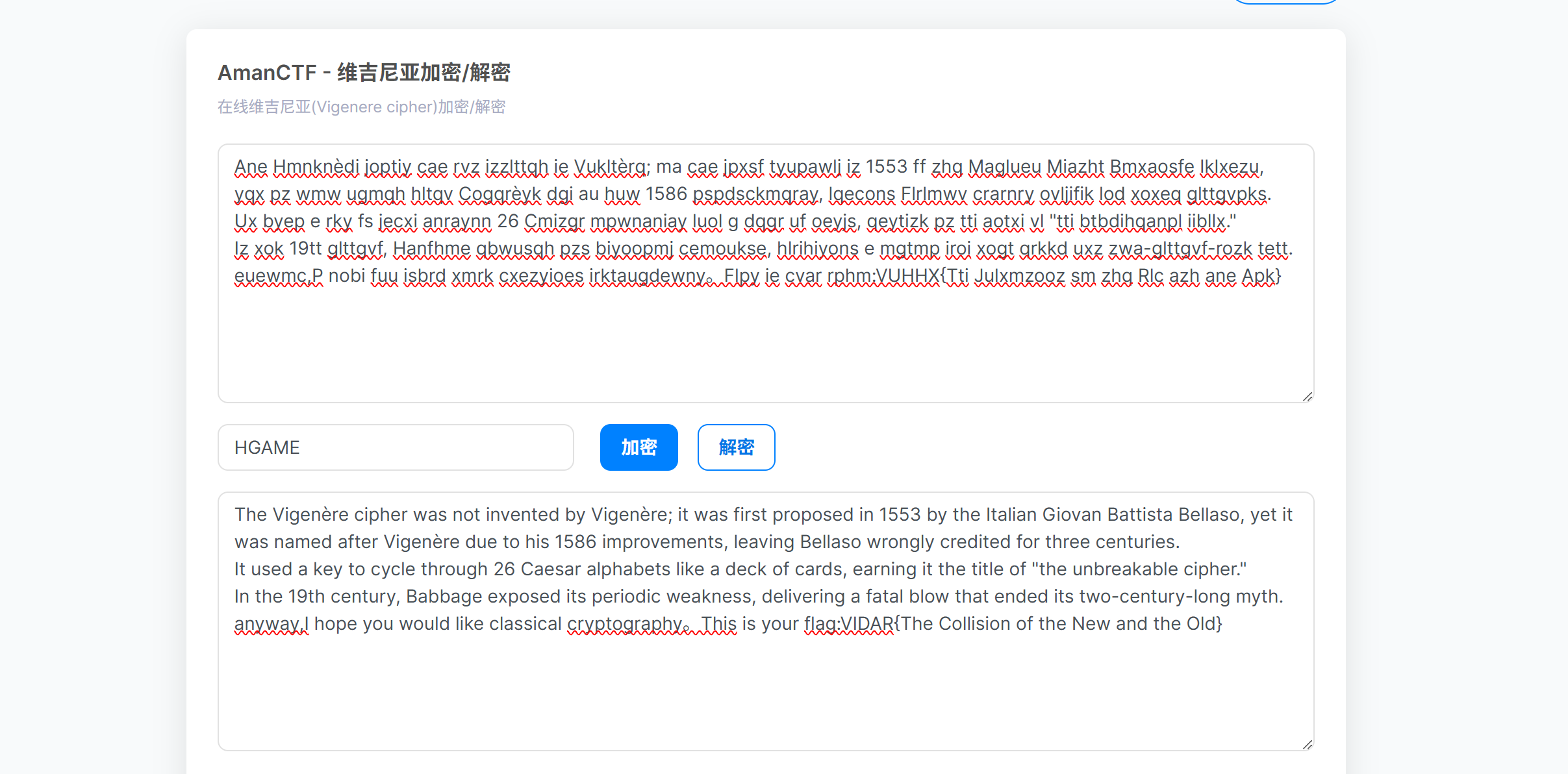
非预期:我直接去盲了一波密钥是 HGAME 竟然给我猜对了。
接下来是预期解法:
给了一个RSA问题,大概是解出之后能得到密钥
# Copy this to SageMath
# 模拟 Crypto 库的功能,避免在线环境报错
def long_to_bytes(val):
    return int(val).to_bytes((int(val).bit_length() + 7) // 8, byteorder='big')

# 题目数据 [2]
n = 103581608824736882681702548494306557458428217716535853516637603198588994047254920265300207713666564839896694140347335581147943392868972670366375164657970346843271269181099927135708348654216625303445930822821038674590817017773788412711991032701431127674068750986033616138121464799190131518444610260228947206957
leak = 6614588561261434084424582030267010885893931492438594708489233399180372535747474192128
c = 38164947954316044802514640871285562707869793354907165622336840432488893861610651450862702262363481097538127040490478908756416851240578677195459996252755566510786486707340107057971217557295217072867673485369358370289506549932119879791474279677563080377456592139035501163534305008864900509896586230830001710243
e = 65537

# 1. 构造多项式
# leak 是 p 右移 230 位,因此 p_high = leak * 2^230
p_high = leak << 230
PR.<x> = PolynomialRing(Zmod(n))
f = p_high + x

# 2. 调用 small_roots
# beta=0.4: 我们寻找模 n 的因子的根,该因子大小约为 n^0.4 (实际上是0.5,但放宽到0.4更稳)
# epsilon=0.01: 调整 LLL 算法的参数
# X=2^231: 稍微放宽上界,确保包含真实根
print("[*] Running Coppersmith attack...")
roots = f.small_roots(X=2^231, beta=0.4, epsilon=0.01)

if roots:
    x0 = roots[0]
    p = p_high + Integer(x0)
    print(f"[+] Recovered p: {p}")

    # 3. 标准 RSA 解密
    if n % p == 0:
        q = n // p
        phi = (p - 1) * (q - 1)
        d = inverse_mod(e, phi)
        m = power_mod(c, d, n)

        flag = long_to_bytes(m)
        print(f"[+] Flag: {flag}")
        try:
            print(f"[+] Decoded: {flag.decode()}")
        except:
            print("[!] Could not decode bytes to utf-8 directly")
    else:
        print("[-] Calculated p is not a factor of n. Check parameters.")
else:
    print("[-] Roots still not found. Try increasing epsilon slightly (e.g., 0.02).")
[*] Running Coppersmith attack...
[+] Recovered p: 11413053109552188507052666630091285760873067504449985234054655694908075994350969330957385458253490012573212730089010386220127731924243642741330801109560321
[+] Flag: b'Vigenere,key=hgame'
[+] Decoded: Vigenere,key=hgame
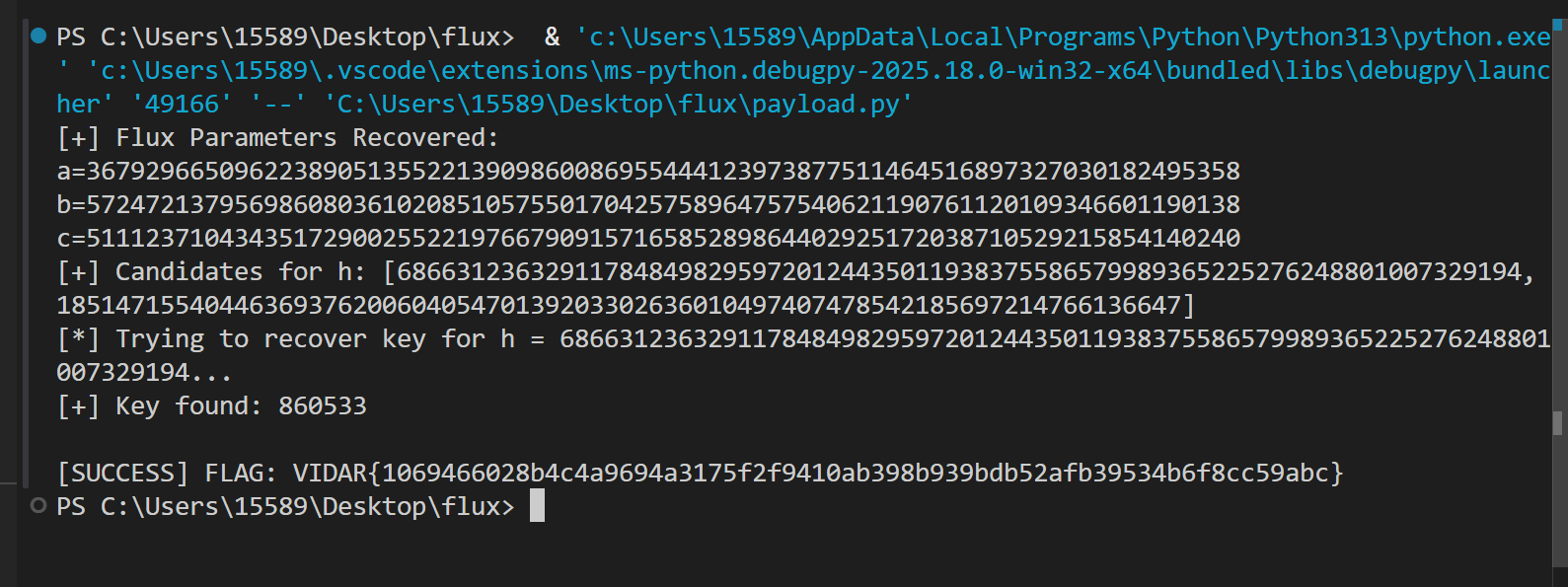
Flux
这是一个典型的CTF密码学题目,主要考察对非线性同余生成器(LCG的变体)的破解以及对混合运算哈希函数的逆向。
解决这个问题的步骤如下:
1. 恢复 Flux 生成器的参数 (a, b, c)
根据代码中的 Flux 类,生成器的状态更新公式为二次同余方程:
$x_{next} = (a \cdot x^2 + b \cdot x + c) \pmod n$ [2]
题目在 data.txt 中提供了模数 $n$ 以及连续生成的4个数值列表 data(设为 $x_1, x_2, x_3, x_4$)[1]。我们可以利用这些已知数值建立方程组:
- $x_2 \equiv a \cdot x_1^2 + b \cdot x_1 + c \pmod n$
- $x_3 \equiv a \cdot x_2^2 + b \cdot x_2 + c \pmod n$
- $x_4 \equiv a \cdot x_3^2 + b \cdot x_3 + c \pmod n$
通过联立方程组(例如两两相减消去 $c$),利用线性代数的方法或高斯消元法在模 $n$ 的有限域下解出参数 $a, b$,最后代回求出 $c$。
2. 逆推初始种子 h
Flux 生成器的初始状态 x 是由 h = shash(value, key) 得到的 [2]。在已知 $a, b, c$ 和第一个输出值 $x_1$ 的情况下,我们需要求解关于初始种子 $h$ 的一元二次方程:
$a \cdot h^2 + b \cdot h + (c – x_1) \equiv 0 \pmod n$
由于 $n$ 是素数(代码中使用 getPrime(260) 生成)[2],可以使用 Tonelli-Shanks 算法或 SageMath 的 solve_mod 函数求出 $h$ 的值。
3. 破解 Key
题目中提到 h = shash(value, key),其中 value 是固定字符串 "Welcome to HGAME 2026!",且 key 的长度小于 70 位 [2]。
shash 函数包含乘法和异或(XOR)的混合运算:
x = (key * x) & mask ^ ord(c) [2]
由于我们已经求出了 h(即 shash 的输出结果),且 key 的位数较短(< 70 bits),我们可以使用 SMT 求解器(如 Z3)来求解 key。将 shash 的逻辑用 Z3 的 BitVec 约束表达出来,设定 key 为未知变量,约束最终计算结果等于步骤2中得到的 h。
4. 生成 Flag
一旦得到了正确的 key,就可以使用代码中给出的最后一步逻辑来获取 Flag:
使用 magic_word = "I get the key now!" 和解出的 key 运行 shash 函数,并将结果转换为十六进制填入格式中 [2]。
总结脚本思路:
- 读取
data.txt获取 $n$ 和 $x_1…x_4$。 - 求解线性方程组得到 $a, b, c$。
- 解二次方程得到 $h$。
- 使用 Z3 求解器根据 $h$ 和明文逆推
key。 - 计算并打印最终 Flag。
from z3 import *
from Crypto.Util.number import inverse

# 1. 加载数据 [1]
data = [259574080588277578527410299002867735023798216356763871244908783144610527451187,
        954408432127642232121971189554605898975195279656270435479524132958262607464595,
        902461413507524665418054778947872375987908929501605791883614896110219051835312,
        92554599789649828855418140915311664257163346975111310560999959858873425332254]
n = 1000081851369905197391900354119969103949357074708517572641608490670646955240669

# 2. 求解 Flux 参数 (a, b, c)
# 建立方程组消元求解
x1, x2, x3, x4 = data

# M * [a, b]^T = R
# (x2 - x3) = a(x1^2 - x2^2) + b(x1 - x2)
# (x3 - x4) = a(x2^2 - x3^2) + b(x2 - x3)

A1 = (x1**2 - x2**2) % n
B1 = (x1 - x2) % n
C1 = (x2 - x3) % n

A2 = (x2**2 - x3**2) % n
B2 = (x2 - x3) % n
C2 = (x3 - x4) % n

# 克拉默法则求解 a, b
det = (A1 * B2 - A2 * B1) % n
det_inv = inverse(det, n)

a = (C1 * B2 - C2 * B1) * det_inv % n
b = (A1 * C2 - A2 * C1) * det_inv % n
c = (x2 - a * x1**2 - b * x1) % n

print(f"[+] Flux Parameters Recovered:\na={a}\nb={b}\nc={c}")

# 3. 求解初始种子 h
# 方程: a*h^2 + b*h + (c - x1) = 0 (mod n)
# 这是一个二次方程,使用 Tonelli-Shanks 算法求解

def legendre(a, p):
    return pow(a, (p - 1) // 2, p)

def tonelli(n, p):
    if legendre(n, p) != 1: return None
    q = p - 1
    s = 0
    while q % 2 == 0:
        q //= 2
        s += 1
    if s == 1:
        return pow(n, (p + 4) // 4, p)
    for z in range(2, p):
        if p - 1 == legendre(z, p):
            c = pow(z, q, p)
            break
    r = pow(n, (q + 1) // 2, p)
    t = pow(n, q, p)
    m = s
    while (t - 1) % p != 0:
        t2 = (t * t) % p
        for i in range(1, m):
            if (t2 - 1) % p == 0:
                break
            t2 = (t2 * t2) % p
        b = pow(c, 1 << (m - i - 1), p)
        r = (r * b) % p
        c = (b * b) % p
        t = (t * c) % p
        m = i
    return r

# 二次方程求根公式
val = (c - x1) % n
delta = (b**2 - 4*a*val) % n
sqrt_delta = tonelli(delta, n)

if sqrt_delta is None:
    print("[-] No solution for h")
    exit()

inv_2a = inverse(2 * a, n)
h_candidates = [
    (-b + sqrt_delta) * inv_2a % n,
    (-b - sqrt_delta) * inv_2a % n
]

print(f"[+] Candidates for h: {h_candidates}")

# 4. 使用 Z3 求解 Key 并计算 Flag
mask = 0xffffffffffffffffffffffffffffffffffffffffffffffffffffffffffffffff

def shash_native(value: str, key: int) -> int:
    length = len(value)
    if length == 0: return 0
    x = (ord(value[0]) << 7) & mask
    for c in value:
        x = (key * x) & mask ^ ord(c)
    x ^= length & mask
    return x

def solve_key(target_h):
    s = Solver()
    # key 长度限制为 70 位 [2]
    key = BitVec('key', 256)
    s.add(key > 0)
    s.add(key < (1 << 70))

    value = "Welcome to HGAME 2026!"

    # 模拟 shash 逻辑
    x = (ord(value[0]) << 7) & mask
    for char in value:
        # Z3 BitVec 乘法会自动处理模 2^256,对应 & mask
        x = (key * x) ^ ord(char)

    length = len(value)
    x = x ^ (length & mask)

    s.add(x == target_h)

    if s.check() == sat:
        return s.model()[key].as_long()
    return None

real_key = None
for h in h_candidates:
    print(f"[*] Trying to recover key for h = {h}...")
    k = solve_key(h)
    if k:
        real_key = k
        print(f"[+] Key found: {real_key}")
        break

if real_key:
    # 5. 生成 Flag [2]
    magic_word = "I get the key now!"
    flag_hash = shash_native(magic_word, real_key)
    flag = "VIDAR{" + hex(flag_hash)[2:] + "}"
    print(f"\n[SUCCESS] FLAG: {flag}")
else:
    print("[-] Failed to recover key.")